Because too much of anything isn't good for anyone. Here's how organisations can assess their change capability and avoid change saturation.Imagine touching down in a new country; the sunshine is like a smile from a long-lost friend. You descend the aeroplane steps, waltz through passport control, and jump in a taxi to your hotel.
The radio plays music in a language you don't know, and the buildings whizzing by are in a style you've never seen. At first, it is exciting.You spend the next few days sightseeing, trying new food, and embracing the changes with open arms. Until, on about the fourth or fifth day, you wake up exhausted. You crave a home-cooked meal. Perhaps you long for a cooler day. And before you know it you are saying, "I need a holiday from my holiday!"
You know what the problem is? Too much change in too short a period of time.
It's easy to see the detriment of this for an individual. But what does it mean on an organisational level?
What Is Change Saturation?
In the simplest terms, change saturation means change overload. It's what happens when an organisation doesn't have the capacity to adopt changes. The two main ingredients of change saturation are change disruption and change capacity.
Change disruption is a sudden, perhaps unexpected, modification to the industry landscape. Examples of change disruption include:
- Technology advancements
- Shifting consumer demand
- Major world events, e.g., COVID-19
- Competitive innovations
Change capacity is the extent to which a business can accommodate the change disruption. For example, the resources available or the quality of change leadership.I
n fact, we found 59% of UK managers and business leaders feel either unsupported or only somewhat supported by their organisation in coping with current job demands, including frequency of change and continued uncertainty as #1.
If you combine the volatile element of change disruption with limited change capacity, your organisation risks becoming destabilised. Unmanaged, this can have explosive consequences.
What Are Consequences of Change Saturation?
Think of a car speeding round a bend too fast, only to end up stuck in a ditch.
As your organisation strives to keep up with the rapid pace of change, you may overshoot a healthy velocity. A bottleneck forms when the number of change initiatives exceeds an organisation's ability to effectively implement them. This might manifest in:
- Lowered productivity
- Change fatigue and burnout
- Job dissatisfaction
- Decreased employee engagement
- Absenteeism and/or increased sick days
If you have implemented significant changes in the workplace and notice a higher-than-usual prevalence of the above issues, you may be facing change saturation.
How to Assess Change in the Workplace
Bogs at the wayside of transformation, in an ideal world, you would avoid them. Prevention is better than a cure, as they say!The best way to do this is to measure and assess change protocols as you go. Think of the following tools as your speedometer to help you gauge when to slow things down.
Assess Change Readiness
A change readiness assessment is a survey that managers share with stakeholders and/or employees at various points during business development. This helps leaders to understand attitudes towards the change, say, whether it is welcome, and how these attitudes fluctuate throughout the process. It also helps to troubleshoot when an organisation has limited capacity to adopt new developments at a given time.
Create Change Heat Maps
Change heat maps are typically created via Excel spreadsheets to track data with a traffic light system. Values are depicted on a spectrum from light green for lower values through amber and up to dark red for higher values. A benefit of heat maps is that it is easy to see at a glance areas that need attention. A disadvantage is that values are typically assigned by one individual (a manager, for example) and could be subject to bias.
Track Change Benefits
Keeping track of change benefits is a great way to see whether the changes are working. Sharing these with employees as you go along is a surefire way to boost morale. Benefit tracking can measure both quantitative and qualitative data, such as:
- Customer satisfaction
- Employee efficiency
- Sales performance
It is best to do this over a longer period of time, as benefits may not be realised immediately.
How to Reduce Change Saturation
Remember the two strands: change disruption and change capacity? These are going to be key for managing change saturation. If you can find a balance between them, you'll be able to push changes through with ease.
Perhaps as you read this, you worry it's too far gone. The wheels are spinning, and you're going nowhere fast. Thankfully, there are ways you can act to mitigate change saturation. The following strategies will get you back on the road in no time.
Decrease Change Disruption
It isn't always possible to avoid change disruption, especially when it comes from an external source, such as from competition or events beyond your control. In many cases, however, it is avoidable.
It isn't change that is the problem here. It's too many changes at the one time.
Decrease change disruption by considering whether a change is truly necessary or whether it can perhaps go on the back burner. You can use the Eisenhower Matrix to prioritise based on importance and urgency.
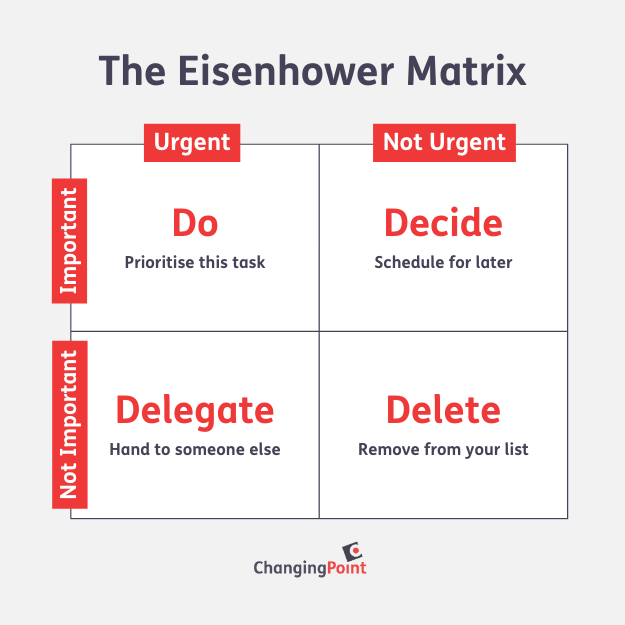
It will be more sustainable in the long run to pour energy into the important and urgent tasks. The others can be delayed until a later date, or ditched entirely.
Build Organisational Change Capability
If developments are essential, you will need to find creative ways to expand the bottleneck and increase the capacity for the change to flow through. Here are some examples of capacity blocks your organisation may be facing, alongside solutions.
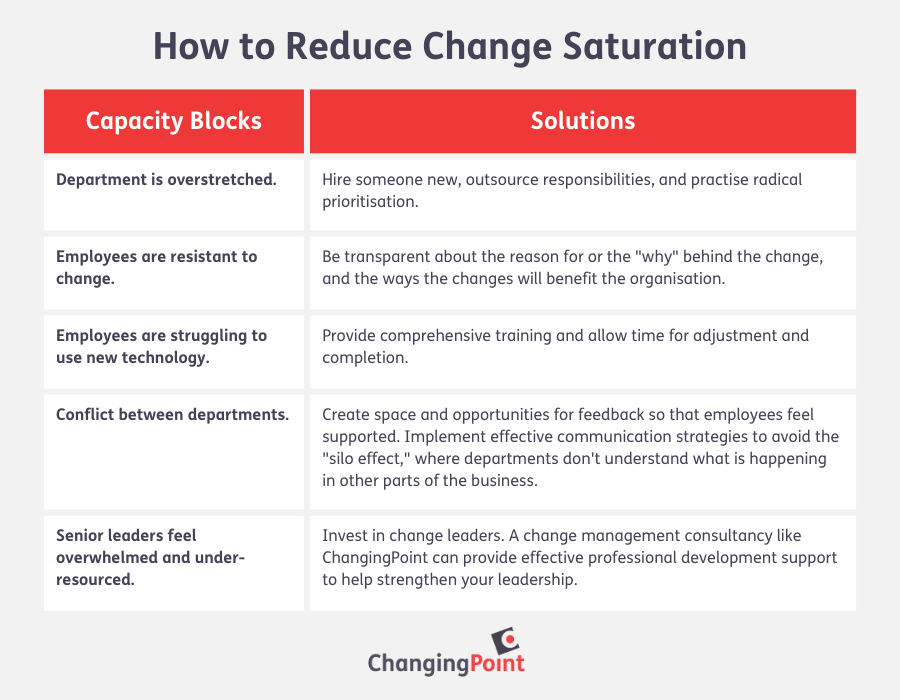
In a nutshell, effective change management involves:
- assessing the change portfolio,
- prioritising change initiatives based on importance/urgency, and
- allocating resources accordingly
But this isn't a once-and-done deal. Now that you have everyone on board, you want to keep them there.
Sustain Change Momentum
Sustaining change momentum requires ongoing commitment and effort. Many promising initiatives fail due to lost momentum, but you can stay on track with a few simple steps:
- Celebrate and share successes
- Maintain open communication both horizontally (between departments) and vertically (between management and staff)
- Broadcast the "why" regularly, including change benefit updates
- Revisit training and professional development opportunities where required
Too much of anything isn't good for anyone.
Let's take a sad office plant. Slouching in the corner, leaves drooping, it is miserable to be there. The soil is dry, or maybe it isn't getting enough sunshine. A well-meaning manager comes along and decides to implement a change.
They pour a couple of jugs of water over it and stick it at the window, in direct sunlight.
A week later, it is dead.
"What went wrong?!" the manager cries. After trying so hard to help it flourish, they assumed there was something wrong with the plant.
The truth is, change is necessary for businesses to thrive. Without it, things get dry. But when you pour it on too thick and fast, you waterlog your employees. It won't kill them, but they'll certainly be tempted to leave.
To help you avoid this, here are strategies for reducing change saturation:
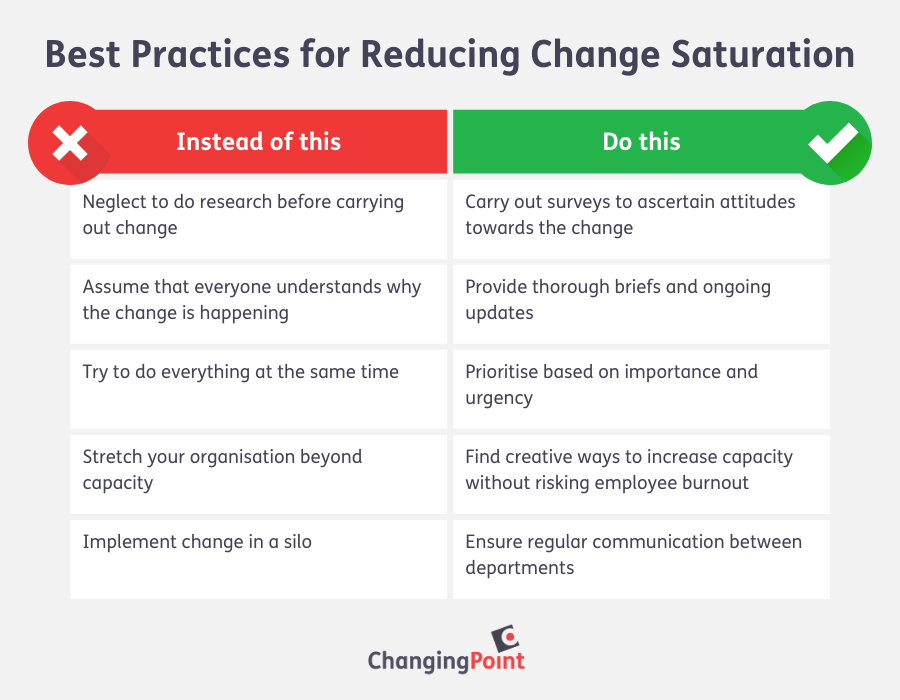
By now you hopefully have a solid grounding in what change saturation is, and how to avoid the collective impact of high change disruption combined with limited change capacity. By following these best practices, organisations can minimise the negative impact of change saturation and achieve their goals—without their employees running for the hills.
For expert guidance and coaching in change management, contact ChangingPoint today.




We’re all about real learning and development, grounded in psychology.
Join our monthly newsletter for fresh insights, research, and events shaping the future of leadership and organisational change.

1 Dysart Street
London
EC2A 2BX
Office 1
Technology House
9 Newton Place
Glasgow
G3 7PR
1 Dysart Street
London
EC2A 2BX
Office 1
Technology House
9 Newton Place
Glasgow
G3 7PR