In today’s dynamic business environment, change is constant and inevitable. Organisations need to adapt to new technologies, market conditions, customer expectations, and internal dynamics in order to maintain a competitive edge.
Change leadership plays a vital role in facilitating this process, ensuring that change initiatives are effectively implemented and embraced across all levels of the organisation. Read on to discover some key principles, challenges and strategies for effective change leadership.
Definition of Change Leadership
Change leadership refers to the ability of individuals or organisations to guide and navigate the process of change effectively. It involves managing the transformational journey and ensuring successful outcomes in the face of evolving circumstances. Change leadership demands various strategies, skills, and approaches that enable leaders to initiate, implement, and sustain change initiatives within their organisations.
Change leadership is crucial for organisations to successfully adapt and thrive in a rapidly evolving landscape. It helps mitigate resistance to change, ensures alignment with organisational goals, and promotes a positive change culture. Effective change leadership enables organisations to embrace innovation, improve performance, and achieve sustainable growth.
Change Leadership vs Change Management
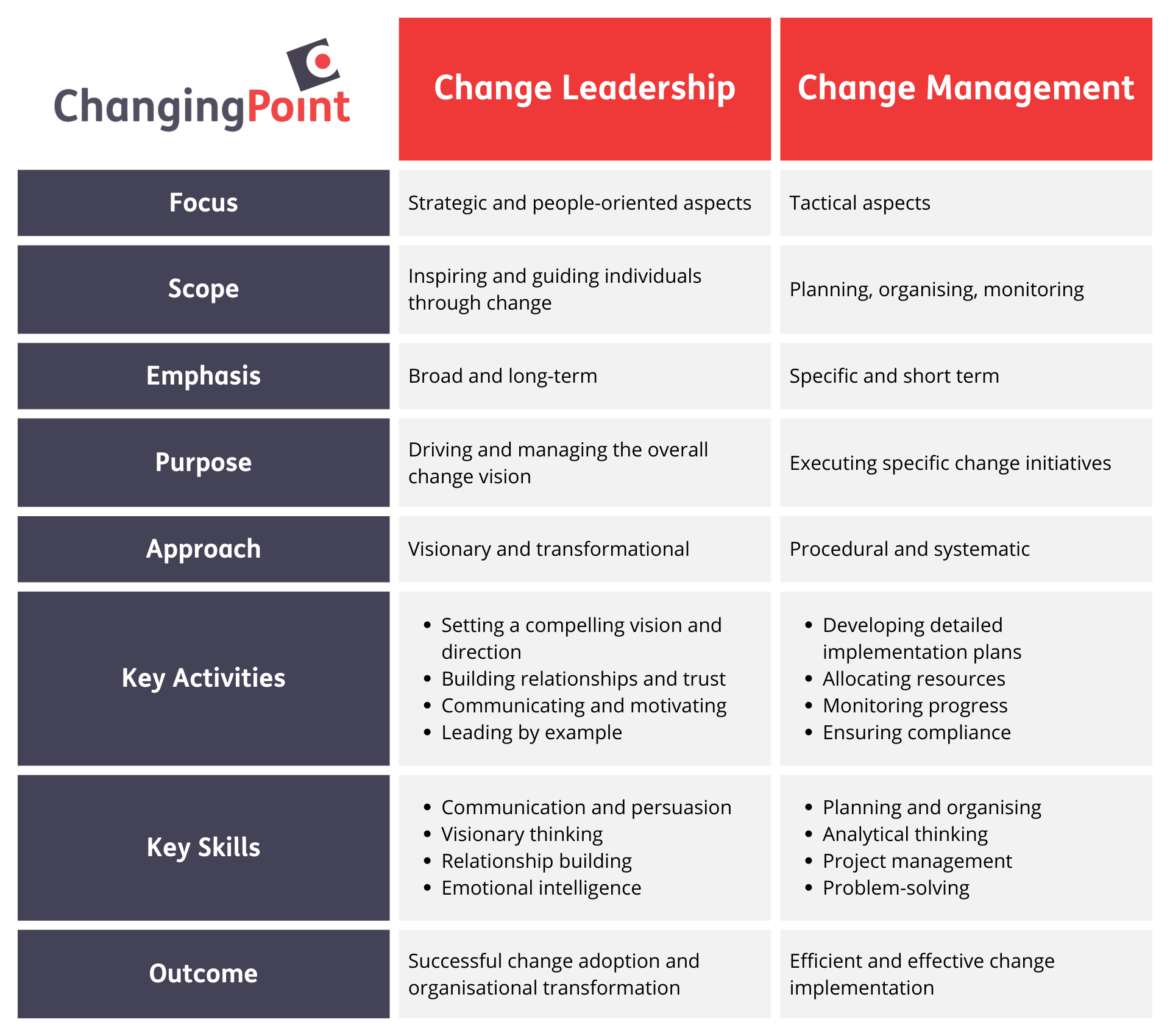
While change leadership and change management are related, they differ in focus and approach.
Change leadership goes beyond merely managing change. It involves proactively leading and inspiring others through the change process. Successful change leaders act as catalysts, driving transformational efforts and creating a vision for the future. They motivate and engage employees, foster collaboration, and help individuals and teams navigate the challenges that arise during periods of change.
In the simplest of terms, change leadership emphasises the strategic and people-oriented aspects, focusing on inspiring and guiding individuals through change. Change management focuses on the tactical aspects of implementing change, such as planning, organising, and monitoring.
Key Principles of Change Leadership
No matter how phenomenal of a leader you are, bringing about change is not a one-man show. Successful change leadership is rooted in several key principles.
Shared Vision and Purpose
Change leaders articulate a compelling, clear vision and purpose that inspires and mobilises others. They communicate the benefits of change, create a sense of urgency, and align individuals and teams towards a common goal.
Change Readiness and Resilience
A mindset of readiness and resilience among employees is imperative to lead change effectively. Change leaders provide the necessary resources, support, and training to help individuals adapt to change, build their capacity, and overcome obstacles.
Stakeholder Engagement and Empowerment
Engaging stakeholders and empowering them throughout the change process is a strong suit of change leaders. It is ideal to actively involve employees in decision-making, seek their input and feedback, and encourage them to contribute their unique perspectives and ideas.
Characteristics of a Change Leader
Leadership in the face of constant change requires certain characteristics for success. Technical expertise is important; people skills however are identified as critical leadership qualities. Effective change leaders need to possess several key attributes.
- Adaptability: Understanding human behaviour and thinking like a psychologist is essential. Leaders must be aware of others’ motivational drivers, adapt their leadership style, and build strong working relationships.
- Agility: In a volatile and uncertain environment, leaders need to challenge assumptions, seek facts, ask the right questions, and practice effective listening. They should avoid relying on behavioural scripts and instead make swift decisions based on the current situation.
- Connectivity: Effective change leaders gather different perspectives from individuals at all levels of the organisation. They adopt a social network approach to leadership, ensuring they are connected to what is happening across the business.
- Focus: It is crucial to avoid getting caught up in every crisis and instead allocate time for strategic thinking and problem-solving. Leaders should remain focused on the overarching change objectives and prepare the organisation for future challenges.
- Innovative Thinking: Leaders must embrace innovation during change, avoiding the reliance on tried and tested methods. They should develop strategic intuition, reconnect existing insights in new ways, and take strategic risks aligned with the company’s mission.
- Resilience: Leaders should be prepared to fail and develop resilience to overcome barriers. Building a positive default response to stressors, maintaining self-confidence, and believing in ideas are key aspects of resilience.
- Hope: Leaders should project hope and inspire certainty in uncertain times. They must engage employees in the future vision and create a positive corporate culture by influencing optimism and resilience.
- Clarity: Clear and honest communication is essential. Leaders should ensure alignment among top-level leaders, cascade a shared vision, and connect it to the individual roles of team members to win group buy-in and direct action.
While this list is not exhaustive, these behaviours provide a foundation for effective change leadership. Leaders should continue to share experiences and stories to expand the understanding of change leadership behaviours.
Strategies for Effective Change Leadership
To effectively lead change, leaders can employ various strategies.
Develop a Comprehensive Change Plan
Change leaders create a well-defined plan that outlines the objectives, timelines, and actions required for successful change implementation. They identify potential risks and develop contingency plans to address unforeseen challenges.
Communicate Openly and Transparently
Effective communication is crucial during times of change. Change leaders communicate openly, honestly, and frequently to keep stakeholders informed, address concerns, and maintain trust and credibility. Engage in two-way communication, actively listening to concerns and feedback from stakeholders.
Build a Change Coalition
Change leaders build a team of change champions and influencers who can support and drive the change efforts. This coalition helps spread the vision, secure buy-in from others, and mobilise resources and support.
Provide Resources and Support
Change leaders ensure that employees have the necessary resources, tools, and support to navigate the change successfully. They provide training, mentorship, and ongoing assistance to help individuals adapt and perform at their best.
Overcoming Challenges in Change Leadership
Implementing change is not without challenges. To lead change effectively, leaders must be prepared to address common obstacles.
Resistance to Change
Change often triggers resistance due to fear, uncertainty, or perceived loss. Change leaders must proactively address resistance by understanding concerns, providing reassurance, and involving stakeholders in the change effort and process.
The digital age has also brought about significant disruptions and opportunities. Change leaders must navigate the complexities of digital transformation by fostering a culture of innovation, embracing technology, and promoting agility and adaptability.
Lack of Alignment
Change initiatives may encounter obstacles when stakeholders have differing priorities or goals. Change leaders must facilitate alignment by clearly communicating the vision, resolving conflicts, and finding common ground.
Insufficient Resources or Support
Inadequate resources or support can hinder change efforts. Change leaders must advocate for the resources required, secure buy-in from key stakeholders, and provide consistent support for successful change implementation.
Examples of Successful Change Leadership
Apple’s Transformation
Apple, under Steve Jobs’ visionary change leadership, transformed from a computer company into a leader in consumer electronics. Jobs recognised the potential of innovative products and seamlessly integrating technology into people’s lives. Through strategic decisions and launches of groundbreaking devices like the iPod, iPhone, and iPad, Apple reshaped industries and became a global consumer electronics leader.
Of course, he didn’t do it alone. The brand’s transformation was a result of galvanising an entire workforce to align with that vision and propel it forwards, which would not have been without its challenges.
“I have learned to listen and to hone my instincts, to be perceptive and to be receptive. To change. To constantly live in ambiguity. How else can leaders today look around the corner and warn others of what’s coming? Only when you follow your instincts and continually renew your mind can your possibilities become realities”
– Angela Ahrendts, Senior Vice President, Apple (Ted Talk, 2013)
Netflix’s Shift
Netflix exemplifies change leadership through its shift from DVD rentals to a streaming platform. Reed Hastings led the company’s transformation by recognising the rise of online streaming and successfully transitioning from physical DVDs to a digital streaming model. By embracing new technologies and understanding changing consumer preferences, Netflix positioned itself as a dominant player in the streaming industry.
Amazon’s Evolution
Under Jeff Bezos’ change leadership, Amazon evolved from an online bookstore into a diversified technology company and global e-commerce powerhouse. Bezos fostered a customer-centric culture and embraced innovation, expanding product categories and introducing Kindle e-readers, Amazon Prime, and AWS. Amazon’s relentless focus on long-term growth and disruptive strategies reshaped the retail industry and established its market dominance.
Beyond the Visionary
In each case, effective change leadership was demonstrated through visionary leaders who recognised industry shifts, articulated clear visions, and successfully navigated their organisations through transformative changes. These examples showcase the power of change leadership in driving organisational success, innovation, and market leadership.
When we look at such examples of change leadership in action, however, we should be mindful not to solely focus on the visionary leaders at the top and accredit the success of initiatives to those minds alone. It goes beyond the vision – the success relies on bringing people with you on the change journey, as Rosalind Brewer so beautifully highlights:
“I think about: Have I ever been bringing enough people along? You can help a peer become a CEO…This is not a competition or a race. We’re better when we move in herds, This is a time for leaders to really evaluate themselves and say, ‘Have I really been the servant leader that I thought I was?” – Rosalind Brewer, CEO, Walgreens (Forbes, 2011)
In Conclusion
Change leadership is a skill that can be developed and enhanced. Leaders can cultivate their change leadership abilities through self-reflection, seeking feedback, pursuing professional development opportunities, and learning from successful change leaders.
Effective change leaders inspire, guide, and engage stakeholders through the change process to drive successful transformations and achieve sustainable growth.
ChangingPoint offers a unique change management programme using the latest thinking from behavioural science to help leaders engage, align, and inspire their people through organisational change. Learn more about our Executive Change Leadership Programme.




We’re all about real learning and development, grounded in psychology.
Join our monthly newsletter for fresh insights, research, and events shaping the future of leadership and organisational change.

1 Dysart Street
London
EC2A 2BX
Office 1
Technology House
9 Newton Place
Glasgow
G3 7PR
1 Dysart Street
London
EC2A 2BX
Office 1
Technology House
9 Newton Place
Glasgow
G3 7PR