Change has become the defining characteristic of the modern business landscape.
In an era of rapid technological advancements, global market shifts, and evolving customer demands, organisations are compelled to embrace change as a fundamental aspect of their growth and survival. However, the success of any change initiative lies not only in the strategy or the tools employed but in the hands of effective change leaders who can guide their teams through the tumultuous waters of transformation.
Businesses must navigate a myriad of challenges, ranging from digital disruption to workforce dynamics, from market volatility to competitive pressures. As organisations strive to remain agile and adaptive, the need for competent change leaders has never been more critical.
10 Organisational Change Statistics That Prove Every Business Needs Effective Change Leaders
But what does it take to be an effective change leader?
It’s more than just a title or a position of authority. True change leadership is an art that requires a unique set of skills, attributes, and a deep understanding of the intricacies of human behaviour and organisational dynamics. Change leaders must possess the ability to inspire and influence, to communicate and collaborate, to manage resistance and foster a culture of innovation.
With real-world insights and statistics across different sources, we will shed light on why every business needs competent change leaders at the helm.
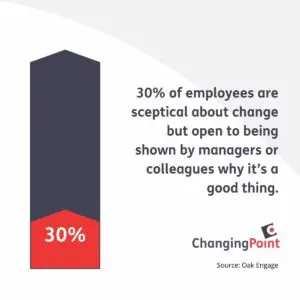
1. 30% of employees are sceptical about change but open to being shown by managers or colleagues why it’s a good thing.
Humans are creatures of habit, and we often become accustomed to familiar routines and ways of doing things. When change disrupts our established patterns, it can evoke feelings of uncertainty, fear, and resistance. Oak Engage’s Change Report shows 30% of employees are sceptical of how change would benefit them or the business, but they are open to hearing why change is a good thing from their managers or colleagues.
This data reiterates the importance of the “why” behind change, and change leaders need to use the change vision as a compass to provide direction, create alignment across departments, and connect the change purpose to organisational strategy.
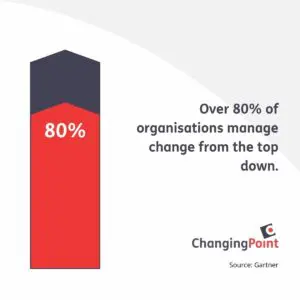
2. Over 80% of organisations manage change from the top down.
Gartner explains that senior leaders often make strategic decisions, create plans, and communicate with the workforce for buy-in. This worked in the past when organisations were vertical and hierarchical, aligning top-down change strategies with structure and workflow.
However, this top-down approach is no longer as effective as it used to be. Organisational changes in today’s workforce require employee engagement and ownership as well as insights and ideas that emerge from employees at different levels. Effective change leaders recognise the importance of collaboration, inclusivity, and empowering employees throughout the change process to drive successful outcomes.
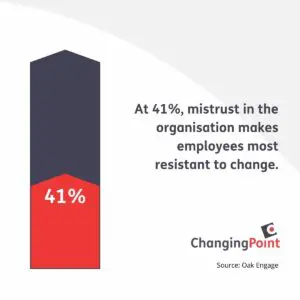
3. At 41%, mistrust in the organisation makes employees most resistant to change.
Trust is the essential foundation for the formation of any relationship, working relationships included. Oak Engage’s Change Report shows 41% of employees agree mistrust in the organisation is the top reason behind resistance to change. This rings true when there is a lack of trust within an organisation, employees are more likely to resist change initiatives, as they may perceive them as threats or potential risks.
Change leaders and trusted leaders; trust is built and strengthened by staying consistent in actions, being selfless in helping out, and providing safety at a company and personal level. Change leaders can reap benefits from building and strengthening trust, especially in times of change and uncertainty.
4. Only 43% of employees say their organisation is good at managing change.
Global disruption is here to stay, and change is constant. Still, most organisations fail to adapt correctly. A recent study by WTW shows that only 43% of employees say their organisation is good at managing change — this is down from nearly 60% in 2019.
The study also points out that organisational changes are driven and brought about by leaders who can instil trust, inspire, and empower their employees. While most of us aren’t born with these leadership characteristics, we can learn and master them. Equipping leaders with the necessary skills and information to lead change is fundamental to effective change management.

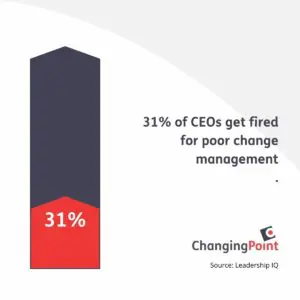
5. 31% of CEOs get fired for poor change management.
Leadership IQ reveals, at 31%, poor change management is the #1 reason behind CEO dismissal, followed by ignoring customers (28%), tolerating low performers (27%), denying reality (23%), and too much talk without enough action (22%).
Effective change leadership is essential for organisations to navigate through periods of transformation successfully. By actively managing resistance, adapting strategies, and ensuring proper implementation, change leaders enable organisations to embrace change, achieve desired outcomes, and avoid the pitfalls that can lead to dismissals.
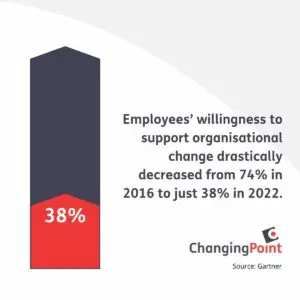
6. Employees’ willingness to support organisational change drastically decreased from 74% in 2016 to just 38% in 2022.
According to Gartner, the average employee underwent ten planned enterprise changes in the past 12 months alone. It is no surprise as to why employees have passive resignation towards organisational changes, resulting in a significant decline in their willingness to support change.
While change leaders play a crucial role in driving organisational transformation, they must also be aware of change fatigue among their employees. By understanding and addressing the impact of change fatigue, change leaders can implement strategies to mitigate its effects, help employees navigate change more effectively, and maintain their engagement and commitment throughout the transformation journey.
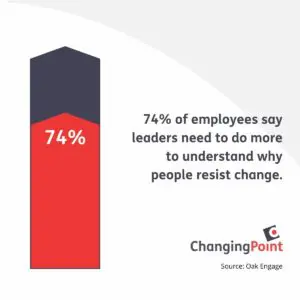
7. 74% of employees say leaders need to do more to understand why people resist change.
If you, as a leader, find your employees resisting change, it’s imperative to understand the underlying concerns, fears, and perspectives of your employees because they can make or break successful change management. Oak Engage’s Change Report speaks volumes about leaders’ understanding of resistance to change as it would retain staff (55%), boost productivity (45%), encourage more collaboration (43%), and improve people’s mental health (45%).
Change leaders need to tailor their communication, provide reassurance, offer training and support, and involve employees in the change process. By acknowledging and empathising with people’s concerns, leaders can build trust, encourage buy-in, and increase the likelihood of successful change implementation.
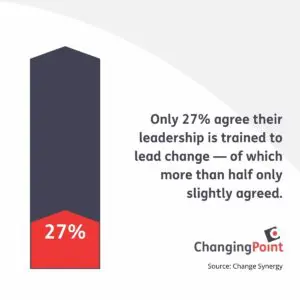
8. Only 27% agree their leadership is trained to lead change — of which more than half only slightly agreed.
A study by Change Synergy shows why organisations fail in change management, and, unsurprisingly, ineffective change leadership is at the top of the list. Only 27% indicated their leadership is trained in their roles, of which more than half only slightly agreed.
This, again, highlights the importance of leadership skills, which can be acquired and mastered. Building a strong change leadership capability is vital for driving successful change initiatives, and change leaders must develop competencies in areas such as communication, influence, empathy, and strategic thinking to successfully navigate organisational transformations.
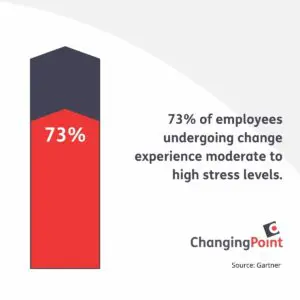
9. 73% of employees undergoing change experience moderate to high stress levels.
Change brings uncertainty; it disrupts people’s sense of control, established routines, or comfort zone. It’s understandable why Gartner found 73% of employees undergoing change experience moderate to high stress levels; the fear of the unknown and the loss of familiarity can weigh heavily on individuals, trigger anxiety, and make it difficult to adapt to new circumstances.
The upheaval caused by change often requires adjusting one’s mindset, embracing flexibility, and seeking support to navigate the uncharted waters ahead. This is where change leaders step in and support employees through change and uncertainty.
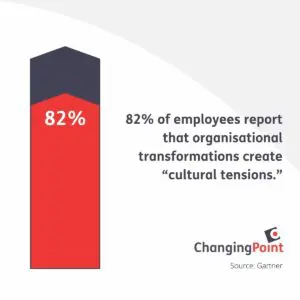
10. 82% of employees report that organisational transformations create “cultural tensions.”
Within the organisational context, cultural tensions are, according to Gartner, competing priorities employees don’t know how to balance in times of change, such as quality vs speed, unity vs diversity, or efficiency vs innovation.
82% of employees experience cultural tensions during change, which exacerbates the stress of change and decreases employee performance. It’s up to change leaders to address these competing priorities and find a balance that aligns with the organisation’s goals and values. If done properly, change leaders can help employees navigate the complexities of change, minimise cultural tensions, and create a supportive environment where individuals feel empowered to adapt and thrive.
And that’s exactly why every business needs effective change leaders.
As we can see, change has become the norm rather than the exception. The statistics presented in this article highlight the crucial role of effective change leaders in driving successful organisational transformations.
Change leaders must go beyond their title or position and possess a unique set of skills to navigate the complexities of human behaviour and organisational dynamics. They must build trust, inspire and influence, communicate and collaborate, manage resistance, and foster a culture of innovation.
ChangingPoint offers tailored organisational development and change leadership programmes that deliver maximum personal and business impact. Contact us today to discover how we can help you navigate organisational changes efficiently and effectively.




We’re all about real learning and development, grounded in psychology.
Join our monthly newsletter for fresh insights, research, and events shaping the future of leadership and organisational change.

1 Dysart Street
London
EC2A 2BX
Office 1
Technology House
9 Newton Place
Glasgow
G3 7PR
1 Dysart Street
London
EC2A 2BX
Office 1
Technology House
9 Newton Place
Glasgow
G3 7PR