Emotional intelligence skills – such as resilience, social influence, creative thinking, and self-awareness, to name a few – are among the top five most sought-after skills in the workplace, 2025 research by the World Economic Forum shows.
This is no surprise. Given the rapid workplace changes wrought by technological advancements, ever-changing trends, and hunger for even more efficiency and automation, businesses need an emotionally intelligent workforce, now more than ever.
What Is Emotional Intelligence?
Emotional intelligence (EI), which is also largely referred to as emotional quotient (EQ), is the ability to understand your own emotions, as well as being able to relate to those of others.
You are likely to have heard of IQ, or intelligence quotient, as the de-facto measurement of cleverness. But the truth is, it is not possible to gain a full picture of someone’s intelligence purely from an IQ test. In fact, Dr Travis Bradberry, author of Emotional Intelligence 2.0, found that 70% of the time people with average IQs outperformed those with high IQs. If those figures don’t seem logical to you, well, that’s where emotional intelligence comes in.
Case in point, it might not be the most mathematically brilliant programmer who gets promoted to manager, but, instead, the decent programmer who demonstrates strong interpersonal skills. If IQ is how we use our minds to relate to tasks, EQ is how we use our minds to relate to people. While many different kinds of intelligence exist, emotional intelligence holds the crown in the workplace.
In a similar vein, there are numerous models for measuring and understanding EI, but for emotional intelligence in the workplace, we will focus on psychologist Daniel Goleman’s mixed model.
Daniel Goleman’s Emotional Intelligence Framework
In his original 1995 research, Goleman divided emotional intelligence into five types: social skills, empathy, self-awareness, motivation, and self-regulation. Since then, he has updated his research to simplify these into four categories. The first two relate to the self; the latter two relate to other people.
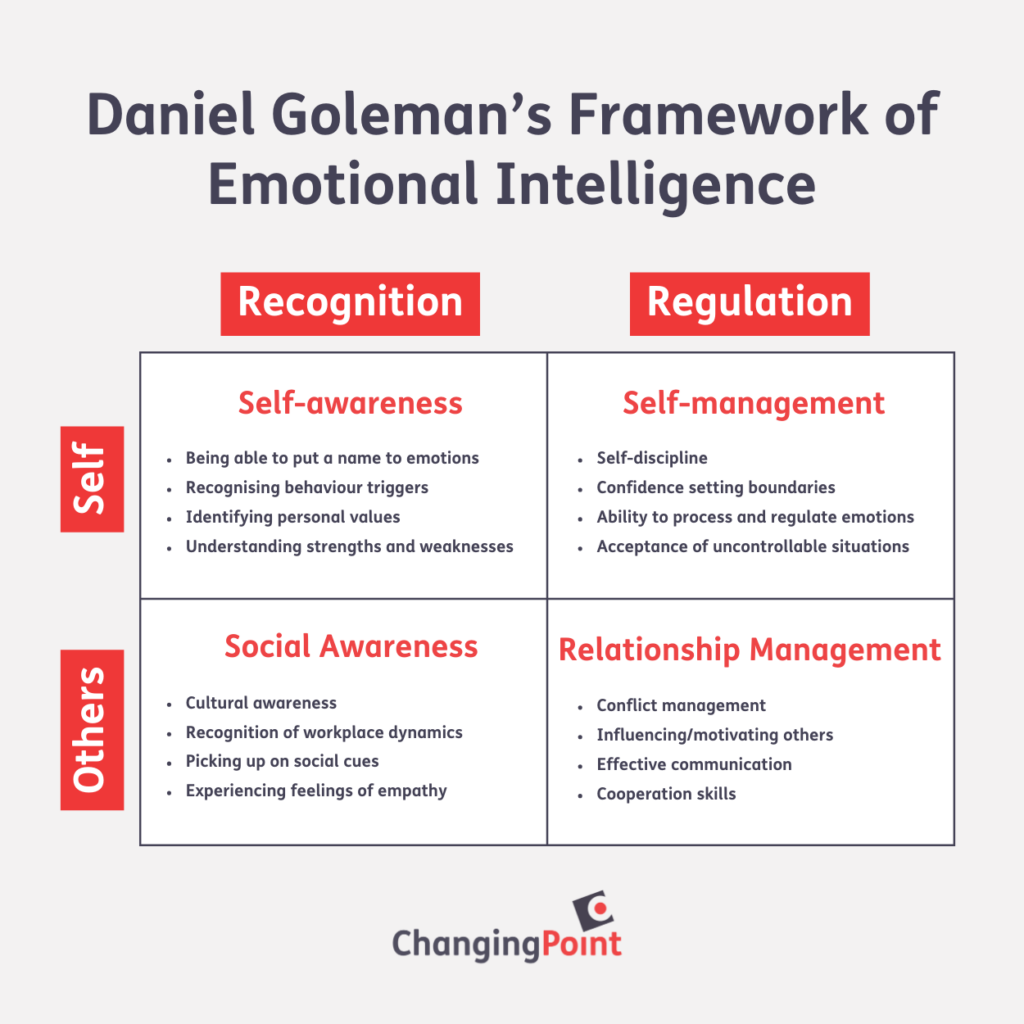
1. Self-awareness
Self-awareness is the ability to put a name to your own physical and emotional sensations, as well as to recognise what triggers them and your corresponding behaviours. By paying attention to how you feel and react, you can be honest with yourself and, crucially, make changes where necessary.
2. Self-management
Where self-awareness is knowing what your emotions are, self-management is about knowing how to process and regulate your emotions in a healthy way.
For example, when someone who struggles to control their anger is able to recognise when they are beginning to feel frustrated, they know:
- When to step away for a breather
- How to process any pent-up feelings at a later point in time, e.g., through engaging in physical activity, talking to someone whom they can confide in, etc.
3. Social Awareness
Once you have a deeper knowledge of yourself, it should hopefully make understanding other people much easier. While no two people are exactly the same, most human beings operate along similar wavelengths and patterns, and are motivated in similar ways.
An example of healthy social awareness at work is understanding that a colleague’s irritation, even if directed at you, has likely been triggered by a multitude of external and internal factors. This knowledge makes it easier to have empathy and avoid responding reactively.
4. Relationship Management
Relationship management means when you know how to relate to and motivate others, using your influence for successful conflict management and the facilitation of collaboration.
Benefits of Emotional Intelligence in the Workplace
When it comes to how emotional intelligence can benefit in workplace settings, the benefits stretch beyond the individuals possessing EI themselves but also to their teams and organisations as a whole.
Benefits of Emotional Intelligence for Employees
- Conflict Management: Many conflicts are unavoidable, and some are even healthy! If, however, left unmanaged, they can quickly turn toxic. Emotionally intelligent employees can draw on social awareness and relationship management skills to understand conflicting perspectives and smooth out conflicts.
- Wellbeing: Our very own research shows that 25% greater leadership wellbeing associated with greater emotional intelligence. In times of change and uncertainty, greater pressure is put on leaders to manage emotional demands, pressures that can be mitigated by higher levels of emotional intelligence.
- Career Longevity: Emotional intelligence also plays a crucial role in career longevity, enabling professionals to navigate workplace challenges, build strong relationships, and adapt to change. In fact, Bradberry’s research shows that 90% of top performers in the workplace exhibit high emotional intelligence, highlighting its impact on sustained success.
- Higher Earnings: According to research reported by Forbes, people with high emotional intelligence earn $29,000 more than people with lower emotional intelligence. Why? Well, when an employee is able to manage stress and work well with others, they increase their chances of receiving promotions, particularly for people management roles.
Benefits of Emotional Intelligence for Businesses
- Better Collaboration: When employees have high emotional intelligence, they are able to understand each other better and, as a result, communicate more effectively. This leads to better teamwork, greater efficiency, and an overall enhanced workplace performance.
- Staff Retention: One of the best things a company can do to retain staff is to help managers develop their emotional intelligence in the workplace. Yes, you heard that right. As the old saying goes, “people don’t leave their jobs, they leave their managers.” When managers know how to motivate and actually understand their teams, staff are more likely to feel valued and see their contribution and presence worthwhile.
- Adaptability: EI is linked to greater resilience towards change, a skill that is invaluable to businesses going through challenging times, or, if we are being really honest here, any business these days. Which brings us to…
- Effective Change Management: High emotional intelligence sets effective leaders apart from those who struggle to lead. It is also a key decider in how smoothly organisational changes can be carried out. This is because managers/leaders with high levels of social awareness and relationship skills are better resourced to navigate the relational side of corporate change.
Examples of Emotional Intelligence in the Workplace
So far, we have covered what emotional intelligence is and its benefits to employees themselves and, by extension, businesses. But what does this really look like in a workplace setting?
Do employees need to be perfectly in tune with their own and others’ emotions all the time? Absolutely not. Simply being “good enough” without the expectation of perfection will go a long, long way to boosting morale and camaraderie.
Practising Active Listening
Those with strong EI go beyond simply hearing what others are saying; they practise active listening. This means giving undivided attention, withholding judgment, and making a genuine effort to understand both the words and emotions behind a message.
When team members feel heard, they are more likely to share ideas, flag issues early, and work collaboratively. Active listening creates a culture of openness and psychological safety, where everyone, regardless of role, feels like their voice matters. Over time, this builds trust and loyalty, making teams stronger and more resilient.
There Is Creative Freedom
Creative freedom thrives where proactive personalities are recognised and supported. Emotional intelligence comes into play when managers and leaders trust their team to let go of micromanagement and give individuals space to innovate.
Being empowered to take ownership of their ideas and decisions helps employees develop a sense of autonomy, motivation, and pride in their work. This becomes especially powerful during times of change, where the ability to think independently and creatively can help teams pivot quickly and come up with solutions others might miss.
Being Open to Courageous Conversations
Courageous conversations are tough discussions around conflict, feedback, or misunderstandings that many shy away from, but emotionally intelligent individuals welcome them. When people feel safe, respected, and heard, they are more willing to engage. It’s not about confrontation for the sake of it but more of clarity, mutual understanding, and forward momentum. Leaders and peers who navigate these conversations without defensiveness, blame, or judgment lay the groundwork for healthier workplace relationships, better teamwork, and fewer tensions.
Remaining Resilient to Change
Change is inevitable, but how people respond to it varies wildly. Leaders who display emotional intelligence recognise this and take a thoughtful, human-centred approach to guiding their teams through transition. Instead of pushing blindly ahead, they communicate the why behind the change, empathise with concerns, and involve staff in the change journey. This builds trust and makes people more inclined to embrace change rather than resist it. Over time, teams become more agile and adaptable, able to handle shifts with confidence instead of fear.
Managing Stress Productively
Stress is unavoidable, but emotionally intelligent leaders know how to respond to it wisely. They remain composed under pressure, model calmness, and act as stabilisers when things feel uncertain. More than that, they are attuned to the energy and emotional temperature of their teams. They know when it’s the right time to push for growth and when it’s smarter to hang back. This emotional calibration can prevent burnout, keep morale high, and ensure that productivity doesn’t come at the cost of workplace wellbeing.

What Does NOT Constitute Emotional Intelligence
We talk a lot about emotional intelligence, but, in practice, it can be quite hard to recognise and pinpoint in dynamic workplace settings. On the other hand, there are some clear examples of behaviours that definitely are NOT emotionally intelligent, even though they are often mistaken as such.
Once you can tell the difference, you are in a much better position to actually develop it.
Being nice or agreeable all the time ≠ EI
People assume that someone who avoids conflict, says “yes” to everything, and tries to keep the peace must be emotionally in tune. However, real emotional intelligence includes the ability to say “no,” hold firm boundaries, and engage in difficult conversations when necessary. Being overly agreeable can signal people-pleasing or fear of confrontation, not self-awareness or emotional regulation.
Suppressing or hiding emotions ≠ EI
Many assume that staying calm and composed, no matter the situation, is a sign of emotional intelligence. In reality, suppressing emotions is NOT the same as managing them. Emotional intelligence, as we mentioned throughout, involves recognising emotions, processing them appropriately, and responding in a healthy way. When emotions are bottled up, they often resurface in unproductive or harmful ways, which could then affect performance and relationships.
Avoiding conflict ≠ EI
The assumption is that someone who never argues must be emotionally mature. Quite the opposite, EI involves managing conflict, not sidestepping it. Emotionally intelligent individuals are willing to address issues constructively and calmly rather than burying tensions or pretending problems don’t exist. Conflict handled well can strengthen trust; avoiding it altogether can undermine it.
Over-empathising without boundaries ≠ EI
Being deeply empathetic is a hallmark of EI, but without boundaries, it can lead to burnout or emotional enmeshment. People who constantly absorb others’ emotions or overextend themselves emotionally may be seen as highly empathetic, but this isn’t sustainable or healthy. Emotional intelligence includes empathy with resilience: the ability to care deeply while maintaining a sense of self and emotional balance.
High intelligence or technical expertise ≠ EI
It’s a common misconception that someone with a high IQ or strong technical competence automatically has emotional intelligence. Being smart or capable doesn’t necessarily mean someone is good at managing relationships, reading emotional cues, or regulating their own emotional responses. Emotional intelligence is a completely different skill set: one rooted in emotional awareness, not cognitive ability.
Toxic positivity or forced optimism ≠ EI
A relentlessly positive attitude, say, always looking on the bright side, dismissing negativity, or insisting on “good vibes only.” This kind of forced optimism can actually shut down real conversations and make people feel unheard. Emotional intelligence means acknowledging and validating emotions, even the uncomfortable ones. It’s not about staying positive at all costs, but about responding to emotions with honesty and empathy.
How to Develop Emotional Intelligence in the Workplace
Though some people – the way they connect and interact with others – might make it feel like emotional intelligence is incredibly innate, emotional intelligence, just like any other skill, can be learned and mastered.
Interestingly, developing emotional intelligence at work might even be safer, as workplaces usually have clearer, more structured boundaries and expectations and less emotional weight than personal settings. And here’s how.
1. Mentorship
In the same way that analytical thinking can be taught, so too can emotional intelligence. Instead of a teacher, however, a mentor is perhaps a more ideal choice for developing EQ. Mentees can grow their self-awareness in the context of professional mentorship, with opportunities for honest feedback and self-reflection.
2. Work journalling
The evidence is clear: journalling is one of the most effective bridges to self-awareness. It’s easy to get pulled along by corporate culture without stopping to acknowledge true feelings about the actual habits and behaviours. With work journalling, employees are given time and space to reflect on their work at the end of the day/week. This helps with stress management, accountability, and identifying any discrepancies between professional goals and actual output.
3. Reframing
Reframing your emotions means finding another way to interpret them. At the end of the day, emotions are neither “good” nor “bad.” They are merely signals that we use as one piece of information among many in our decision-making. We have a choice in how to use the energy of emotion.
For example, if you feel jealous about a colleague receiving a promotion, you could either use the jealousy as a means to wallow in bitter feelings, or you could take it as a signal that you need to develop your confidence and work ethic.
4. Stress management techniques
Many workplace conflicts are the result of poorly managed stress and employees not being given time and space to do their jobs properly. Giving adequate breaks and providing stress relief activities, such as mindfulness sessions, can help to cultivate a work culture in which it is normal for people to take stock of their emotions. This will help employees move forward with clear-headed intentionality, leading to better decision-making.
5. Empathy building activities
The heart of emotional intelligence is empathy. When you go into conversations with a desire to try and understand the person you are speaking to, it’s much easier to find ways to relate to them. Employees can cultivate empathy for each other by using techniques such as active listening and perspective-taking.
- Active listening means paying full attention to your conversation partner, using body language cues and open questions to understand them better.
- Perspective-taking is about putting yourself in someone else’s shoes—that is, choosing to temporarily take on their perspective in order to better understand it. This can be done through role-playing workshops or by providing more opportunities for group socialising.
6. Creative expression sessions
Businesses can strengthen the link between emotional intelligence and creative thinking with creative expression sessions. This could look like booking an art therapist or shaking up a boardroom meeting with some creative mind map brainstorming. Either way, bringing creativity into the picture will help to build stronger connections between colleagues and provide a healthy outlet for unexpressed emotions.
7. Behavioural change programme
Remember what we said earlier about retention, particularly about how helping managers and leaders develop EI can help keep turnover at bay? This is where structured programmes for behavioural change, like ours at ChangingPoint, enter.
A sound behavioural change programme often begins with reflective practices, helping individuals to recognise their triggers, understand how their own emotions and moods affect others, and identify patterns in their decision-making and interpersonal behaviours. At ChangingPoint, we leverage Roche Martin Emotional Capital Self Reports and 360° Feedback Reports to provide an in-depth understanding of leadership emotional intelligence across 10 competencies linked to professional performance.
Such programmes can be integral in providing a safe space, not only to practise but also to be able to make mistakes without judgement and repercussions. This might look like exercises or coaching for specific skills, e.g., self-awareness, self-regulation, and empathy, just to name a few.




We’re all about real learning and development, grounded in psychology.
Join our monthly newsletter for fresh insights, research, and events shaping the future of leadership and organisational change.

1 Dysart Street
London
EC2A 2BX
Office 1
Technology House
9 Newton Place
Glasgow
G3 7PR
1 Dysart Street
London
EC2A 2BX
Office 1
Technology House
9 Newton Place
Glasgow
G3 7PR