The Eisenhower matrix is a widely shared tool for prioritising. Less well known is the more personal review that can make it meaningful: looking at the demands we face and the resources we have to meet them. Here's how bringing the two together can help leaders decide where their time and energy go, in a way that supports both their effectiveness and their wellbeing.
Why urgent wins
You've blocked an hour to think about next year's priorities. Ten minutes in, an email arrives marked urgent. You tell yourself you'll deal with it quickly. The hour goes.
This isn't simply a question of will power. Researchers Zhu et al. (2018) found that people tend to choose urgent tasks over important ones, even when the important task offers a clearly bigger payoff. They called it the mere urgency effect: a short deadline is enough to make a task feel more important than it is.
There's an emotional pull too. Solving an urgent problem brings instant results: we feel useful, and there's a temporary high in fixing something now (Covey et al., 1994). But when we later recall the bigger task that was pushed aside, we can feel a sense of loss (Hummel, 1967).That brings a psychological demand of its own: the nagging sense that we're not focusing on what our role really needs from us.
Over time, this push and pull between the short term and the long term can leave us feeling overwhelmed: busy all day, yet not moving forward on what matters most. Breaking the cycle takes a different way of thinking: responding well to what's pressing in the short term, while deliberately making room for what matters in the long term.
The Eisenhower matrix: a simple lens on where your time goes
One of the best-known tools for managing this tension is a simple two-by-two grid, and you may already be familiar with it. It takes its name from Dwight D. Eisenhower, who in a 1954 speech quoted a college president: ‘I have two kinds of problems, the urgent and the important. The urgent are not important, and the important are never urgent.’ Stephen Covey (1989) later turned the idea into the four-quadrant grid.
The matrix sorts work using two questions: is it urgent, and is it important?
Urgent and important: crises, pressing problems, real deadlines. Usually dealt with now.
Important but not urgent: planning, building relationships, developing people, preventing problems. Best scheduled, before it becomes urgent.
Urgent but not important: requests that need a quick response, but aren't where you add the most value. These may call for managing expectations, or delegating.
Not urgent and not important: busywork, unnecessary meetings, distractions. Best reduced or removed.
Its real value is the pause it creates. Harvard Business School's Joseph Fuller (quoted in Heinrich, 2026) argues that managers often act on problems too quickly. Learning to pause before acting is a core leadership skill, and simply asking ‘Is this genuinely important, or does it just feel pressing?’ is a direct challenge to the urgency effect.
Used too simplistically, though, the matrix has limits:
Importance isn't fixed. It depends on your role, context and relationships. A task may matter little while the person behind it matters a great deal: a key stakeholder whose relationship you need to navigate, or a team member who needs your time and attention more than an answer.
Time isn't the only resource. Two weeks with the same tasks can feel very different depending on your energy, your support and your team's capacity.
Sorting isn't the same as acting. Putting tasks into boxes is the easy part. Acting on it takes leadership behaviours: pausing before saying yes, managing expectations, delegating with support, and protecting time when others want it.
So the matrix is most useful as a regular check on where your time and energy are going, and whether that's where you add the greatest value. Looking at your demands and resources can help you answer that question.
Demands and resources: a lens on effectiveness and wellbeing
The job demands–resources (JD-R) model, developed by Demerouti, Bakker and colleagues (Demerouti et al., 2001), is now one of the most widely used theories of wellbeing and performance at work. It's flexible: rather than a fixed list, it recognises that every role has its own mix of demands and resources (Bakker & Demerouti, 2024).
Demands are the parts of work that take sustained effort, and so carry a physical or psychological cost. They come in different forms:
Workload: volume of work and time pressure.
Cognitive: complex problems, constant switching between tasks.
Emotional: difficult conversations, conflict, supporting others through change.
Work–home: when work spills into home life, or the other way round.
Personal: the standards and expectations we set for ourselves (Demerouti & Bakker, 2023).
This distinction matters. Sometimes it isn't the tasks themselves that leave us feeling overwhelmed, but the emotional or personal demands that come with them.
Resources are the physical, psychological, social or organisational aspects of work that help us achieve our goals, ease the impact of demands, and grow. More time, budget and capacity still matter, but resources go well beyond them:
Social: support from colleagues, a trusted peer, a network outside your organisation.
Feedback and recognition: knowing how you're doing, and that it's valued.
Autonomy: some control over how and when you work.
Development: opportunities to learn and grow.
Personal: confidence, optimism, resilience.
Beyond work: family, friends, rest and recovery (Demerouti & Bakker, 2023; Duan et al., 2024).
The model shows how demands and resources shape both our wellbeing and our effectiveness:
Wellbeing. When demands stay high over a long period without enough resources, they wear down physical, emotional and mental energy. Short-term tiredness can become chronic exhaustion (Bakker & Demerouti, 2024).
Effectiveness. Resources support motivation and engagement, and through them, performance. They also buffer demands: support and feedback, for example, can soften the impact of a heavy workload. And they matter most when demands are high (Bakker, Demerouti & Sanz-Vergel, 2023).
So the aim isn't to remove demands. Some, such as responsibility and complex problems, can be energising: a source of challenge and growth. The aim is to keep demands and resources in balance.
Two more points are worth noting:
Vicious and virtuous circles. When demands stay high, people under strain are at greater risk of making mistakes, and may fall back on short-term coping that creates more demands. When resources are strong, people are more likely to shape their work proactively, which can build more resources (Bakker & Demerouti, 2024).
Resources can be created, not just used. Research with senior executives (Duan, Yao & Qi, 2024) found they drew on resources inside the organisation (colleagues, shared accountability, their own authority to change processes) and outside it (networks, family, professional support), and actively created new ones.
All of this points to one habit: reviewing your demands and resources regularly, not just when you're already stretched.
Bringing the two lenses together
Put the two together and the matrix asks a richer question. Not just ‘Which box does this go in?’ but ‘What does this demand of me, and what resources can I draw on to meet it?
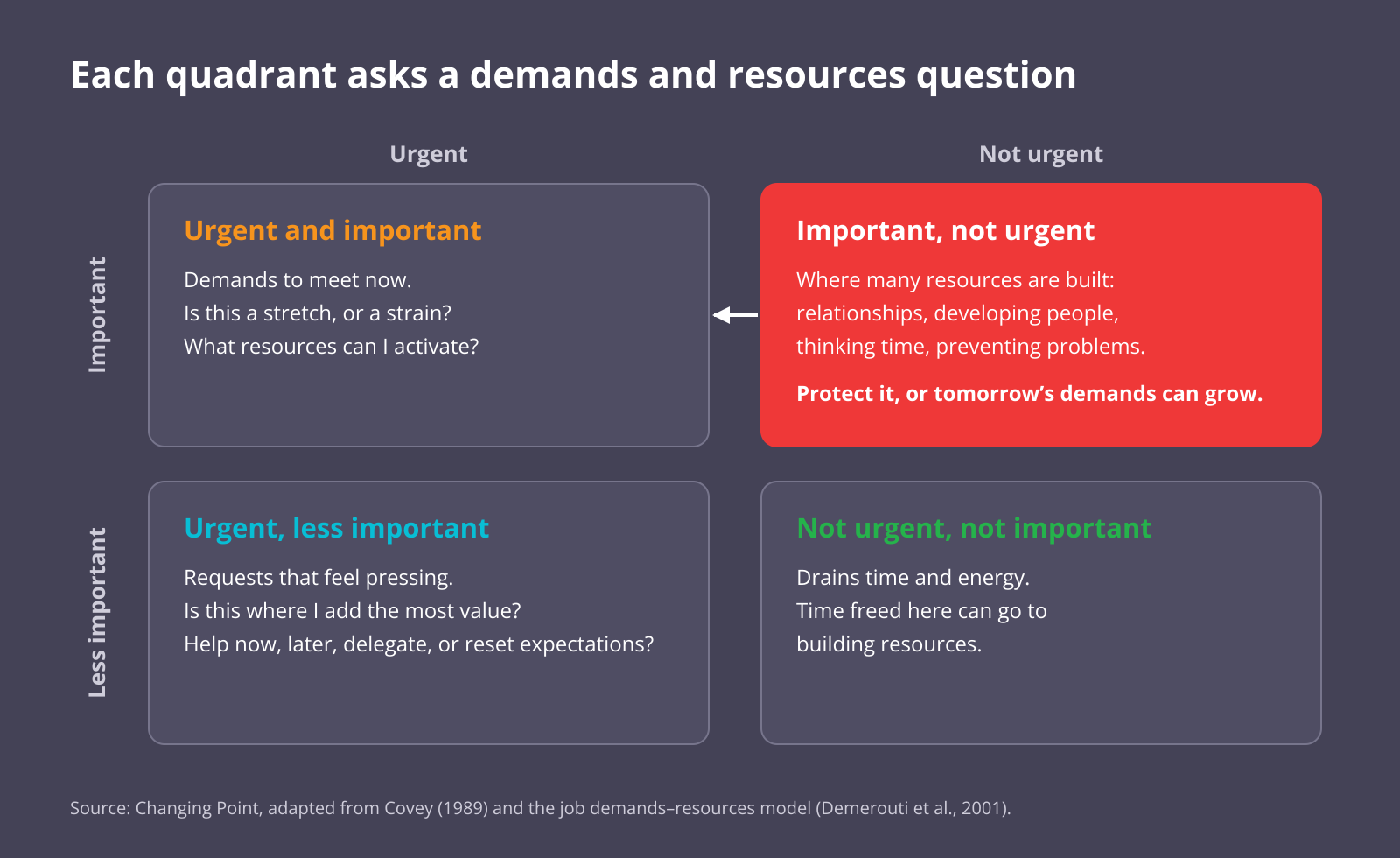
There's an important link between the top two quadrants. Much of the important but not urgent work is resource-building: the relationships, team capability, thinking time and prevention that make urgent demands easier to meet. Skip it for long enough, and the urgent quadrant can grow.
The bottom left quadrant shows why behaviour matters as much as sorting. Not every request needs doing by you, now. It might be right to help straight away, to delegate, or to have a conversation that resets expectations. And where the relationship matters even if the task doesn't, support can be time-bound: ‘I'd like to help with this. Today's tricky because of X, but could we talk first thing tomorrow?’ Delegating well and handling these conversations are themselves resources worth building.
Bringing this together: the matrix shows where your time and energy are going. Demands and resources help you judge whether that's sustainable, and what might need to shift.
Ten minutes at the start and end of the week
Putting this into practice can be simple: ten minutes at the start of the week and ten at the end. You might draw four boxes to represent the matrix, or simply note your thoughts against each question below. The value builds over time: regular check-ins help you spot patterns and adjust as your demands and resources change.
At the start of the week
Important, not urgent
What's one small step I could take on each of these this week?
When in my diary will I protect time for these? (Day, time, how long?)
Urgent and important
Is this a stretch I can meet, or a strain I can't sustain?
What resources can I draw on to meet these demands? (For example: team members, other departments, time to recover outside work.)
Urgent, less important
What's my default response to these requests, and what do I need to be mindful of?
For each one: should I help now, offer a set time later, delegate, or reset expectations?
Not urgent, not important
What could I shorten or drop?
What's most likely to pull me into this box, and what will I do when it happens?
At the end of the week
Where did my time and energy really go, compared with my plan?
What's one thing I'll do differently next week?
Over a few weeks, patterns start to show in both your demands and your resources. On the demands side, it might be the request that always lands on a Monday, or the meeting that always overruns. On the resources side, it might be the conversations that leave you energised, or the difference it makes to start the day with thinking time before opening your emails.
What changes as your role grows
As your role grows, your demands change. They become less about tasks you can complete yourself, and more about people, relationships, ambiguity and competing priorities. Where you add the greatest value shifts too: less from what you do yourself, and more from the conditions you create for others.
That makes leaders a source of demands and resources for their teams, as well as managers of their own. A review of 139studies by Tummers and Bakker (2021) found that leaders affect their people in three ways:
What's on their plate: the demands and resources in their roles.
How heavy it feels: how much those demands wear people down, which leaders can ease through the support they give.
The environment they create: whether it offers autonomy and encourages people to learn, ask for feedback and shape their own work.
So the matrix becomes a team question too. When you protect time to develop someone, you build a resource for them and for you. When you delegate well, you pass on a demand together with the support to meet it and a chance to grow, and both of those are resources. When the whole team's work is stuck in the urgent quadrant, that's a signal to look at the balance of demands and resources, not just to push harder.
The matrix shows where your time and energy are going. Demands and resources help you see the impact of that allocation, and what might need to shift to sustain both your effectiveness and your wellbeing.
A good place to start: where could one resource you build now make next month’s demands easier to meet?
References
Bakker, A. B., & Demerouti, E. (2024). Job demands–resources theory: Frequently asked questions. Journal of Occupational Health Psychology, 29(3), 188–200.
Bakker, A. B., Demerouti, E., & Sanz-Vergel, A. (2023). Job demands–resources theory: Ten years later. Annual Review of Organizational Psychology and Organizational Behavior, 10, 25–53.
Covey, S. R. (1989). The 7 Habits of Highly Effective People. Free Press.
Covey, S. R., Merrill, A. R., & Merrill, R. R. (1994). First Things First. Simon & Schuster.
Demerouti, E., & Bakker, A.B. (2023). Job demands–resources theory in times of crises: New propositions. Organizational Psychology Review, 13(3), 209–236.
Demerouti, E., Bakker, A. B.,Nachreiner, F., & Schaufeli, W. B. (2001). The job demands–resources model of burnout. Journal of Applied Psychology, 86(3), 499–512.
Duan, Z., Yao, C., & Qi, H.(2024). Extending the job demands–resources theory beyond the work domain: Narratives of Chinese senior executives. Journal of Managerial Psychology, 39(1), 67–82.
Heinrich, A. (2026). How to prioritize tasks effectively using the Eisenhower matrix. Harvard Business School Online.
Hummel, C. E. (1967). Tyranny of the Urgent. InterVarsity Press.
Tummers, L. G., & Bakker, A. B. (2021). Leadership and job demands–resources theory: A systematic review. Frontiers in Psychology, 12, 722080.
Zhu, M., Yang, Y., & Hsee,C. K. (2018). The mere urgency effect. Journal of Consumer Research, 45(3), 673–690.







We’re all about real learning and development, grounded in psychology.
Join our monthly newsletter for fresh insights, research, and events shaping the future of leadership and organisational change.

1 Dysart Street
London
EC2A 2BX
Office 1
Technology House
9 Newton Place
Glasgow
G3 7PR
1 Dysart Street
London
EC2A 2BX
Office 1
Technology House
9 Newton Place
Glasgow
G3 7PR