Earlier this year, ChangingPoint surveyed UK managers and business leaders, exploring how emotional intelligence impacts change leadership and increasing demands of organisational change. Here's what we found.We truly believe that change leadership requires understanding both the rational and emotional dynamics of organisational change. And what we value here is the power of evidence-based insights in driving meaningful change. This is the very reason why we decided to look at:
How important is emotional intelligence for leaders in managing job demands and protecting workplace wellbeing during uncertain times?
Through our comprehensive study involving UK-based leaders from across various sectors, we uncovered compelling evidence demonstrating the significant impact of emotional intelligence on leadership wellbeing when explored within the context of leading through change and uncertainty.
Our conclusions come from the detailed analysis of real-life experiences shared by 96 UK-based leaders across organisational levels, from Heads of Departments to C-suite executives, of which over 50% had more than 10 years of leadership experience.
Our research, The EQ Edge, revealed:
- 59% of UK managers and business leaders feel either unsupported or only somewhat supported by their organisation in coping with current job demands.
- 65% of UK managers and business leaders feel that they lack the resources they need to manage change effectively.
- 25% greater leadership wellbeing associated with greater emotional intelligence.
What Job Demands Are Leaders Facing Today
Leaders face unique job demands that test their resilience, adaptability, and emotional intelligence. This is encapsulated in one of many responses we got asking what the most pressing job demands and leadership challenges they encounter in their role today are, and how they manage them.
"My role as Head of HR means that I am tasked with maintaining engagement, keeping everyone happy, supporting our people and other leaders. However, these things are incredibly difficult to do in an environment of constant uncertainty about the future of the business and without money. Up until now I have managed this by basically using all my own emotional energy to support others, find avenues of positivity, and make what helpful changes I can within the limits I've been given. However, I feel like my well has run dry and I don't know where to find the energy anymore to keep doing it."
Head of Department, Unspecified Sector.
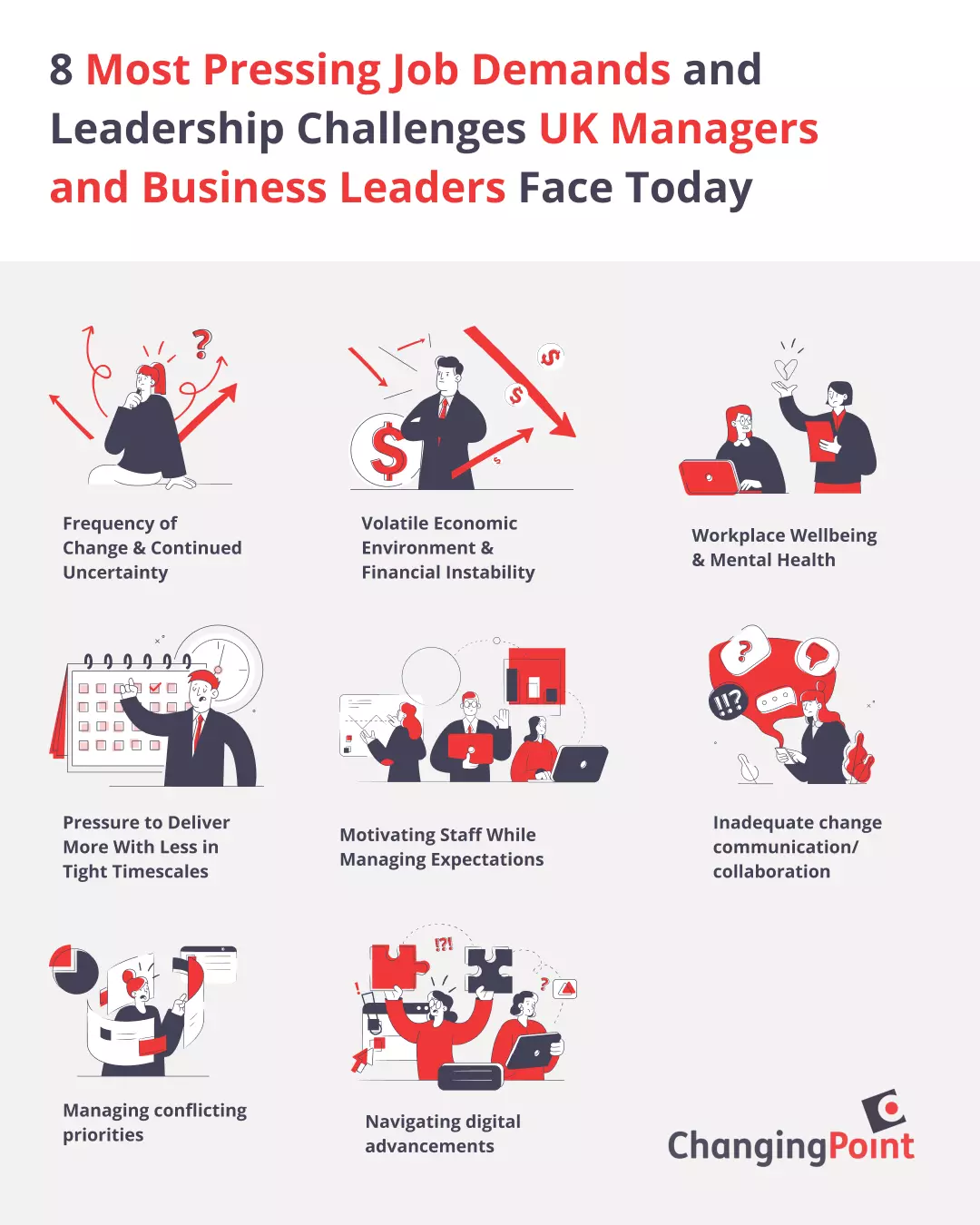
We found that the top 8 most pressing job demands and change leadership challenges facing leaders today are:
- Frequency of change and continued uncertainty
- Volatile economic environment and financial instability
- Workplace wellbeing and mental health (leaders and staff)
- Pressure to deliver more with less in tight timescales
- Motivating staff while managing expectations
- Inadequate change communication/collaboration
- Managing conflicting priorities
- Navigating digital advancement
What Job Resources Do Leaders Need
When it comes to resources, they span physical, psychological, social, and organisational aspects of the job that help leaders achieve both their personal and their organisation's goals. Recent research has shown that when job resources are high, they can mitigate the negative impact of job demands on wellbeing and performance. Simply put, when leaders are properly and adequately supported, they experience less stress and burnout, which, as a result, leads to improved performance.
As leaders spearhead organisational change and navigate its complexities, leadership wellbeing is, unfortunately, often on the back burner.
"Sometimes there is not enough time and space given to talking about the pressures of managing large scale change and if you say anything, it looks like you are struggling and can't cope"
Director, Recruitment and HR.
Leadership wellbeing deserves as much attention as anyone else's, especially in the context of change. A leader's wellbeing has a trickle-down effect on team morale and resilience, influences decision-making, and sets a powerful example of prioritising work-life balance.
Why Emotional Intelligence Can Be a Key Resource for Leadership Wellbeing
Emotional intelligence, or EI for short, is one's ability to understand and manage their own emotions and feelings as well as those of others around them. Emotional intelligence is at play in most, if not all, facets of our lives—work included.In the workplace, emotional intelligence can help leaders to:
- Better manage stress and self regulate their emotions
- Be more adaptable in their approach(es)
- Develop better relationships and communication skills
- Proactively recognise and address their own wellbeing needs
- Better understand and support their team members' wellbeing needs
Building on emotional intelligence in leadership as a powerful resource for navigating the complexities of change, we found 10 key change leadership skills, strategies, and techniques used as resources by leaders in response to today's change demands:
- Vulnerability: Leaders' willingness and ability to openly acknowledge their own emotions, limitations, and uncertainties while maintaining the courage to take necessary risks and make decisions in the face of ambiguity.
- Empathy: Leaders' desire to understand, share, and respond appropriately to the feelings, thoughts, and experiences of others.
- Self-awareness: Leaders' desire to be fully conscious, attentive, and engaged in the current moment—bring their "whole self" to work.
- Self-regulation: Techniques that leaders use to monitor, manage, and modulate their own emotions, thoughts, and behaviours.
- Adaptability: Leaders' willingness to (1.) "pivot and move with the changing landscape" and (2.) seek input, information, and ideas from others during times of change and uncertainty.
- Resilience: Techniques that leaders use to withstand, recover from, and adapt to stress, adversity, and change while maintaining psychological wellbeing and leadership effectiveness.
- Connection: Leaders' efforts to prioritise, establish, and maintain meaningful relationships within their teams and across the wider business.
- Growth: Leaders' commitment to continuous personal and professional development, coupled with the ability to cultivate a growth mindset within their team and organisation throughout periods of change.
- Candour: Leaders' desire to communicate honestly, directly, and transparency during change, while maintaining respect and empathy for others.
- Balance: Adjustments leaders described they had made to help them navigate between competing demands, recognise personal limits, and make decisions that maintained integrity, effectiveness, and wellbeing.
Leadership Development With ChangingPoint
Our findings underscore the significant role emotional intelligence in leadership plays in times of change or uncertainty.
By combining targeted emotional intelligence development with practical change leadership experiences, organisations can create a more robust framework for preparing leaders at all levels to navigate the complexities of change while maintaining their wellbeing.
"ChangingPoint were engaged to work with myself and my Partner team during a period of significant change following the departure of our Division's Senior Partner. The focus on creating a positive culture has led to our team having a positive environment within which we can effectively deliver a high-quality service to our clients. As a direct result of that positivity, we have experienced a significant increase in financial performance. I cannot recommend ChangingPoint enough."
Partner, Legal Firm
ChangingPoint has helped leaders at all levels and businesses across different industries to engage, align, and inspire their people through organisational change. Our psychology-led, behavioural science-backed approach empowers leaders to develop emotional intelligence skills as well as change mindset and behaviours.Our Executive Change Leadership Programme offers leaders a valuable opportunity to step back from daily pressures and explore how to provide effective change leadership with long-lasting, positive results.
Your leaders deserve all the support they can get. Don't wait until challenges come knocking to realise they need help—by then, it might be too late.
Reach out and see how we can help you equip your leaders with the mindset, skills, and strategies to bring their teams onboard and drive meaningful change effectively.




We’re all about real learning and development, grounded in psychology.
Join our monthly newsletter for fresh insights, research, and events shaping the future of leadership and organisational change.

1 Dysart Street
London
EC2A 2BX
Office 1
Technology House
9 Newton Place
Glasgow
G3 7PR
1 Dysart Street
London
EC2A 2BX
Office 1
Technology House
9 Newton Place
Glasgow
G3 7PR